
Adapting Regenerative Agriculture Principles to a New Mexico Large Scale, Leased Ranch

Note: This article is an edited excerpt from Ariel Greenwood’s presentation titled “Putting It All Together—Adapting Principles of Regenerative Agriculture to an Extensive Scale, Leased Commercial Ranch” at the 2025 REGENERATE Conference in Santa Fe, New Mexico.
Today I wanted to give the kind of talk that I always wanted to hear at a regenerative agriculture conference. One that was really specific, and one that dealt with as many constraints and limitations as well as the possibilities. My hope is that by sharing some about our situation and our context, you'll all have something that you can take away.
I wanted to share how we adapted those principles for our situation so we can be a specific case study to share. How do we not only steward land, but restore certain aspects of it as lessees in a commercial operation? To answer that question I will also need to talk about partnerships, relationships, and land access.
The Leased Ranch

So, we are lessees on a large ranch in northeastern New Mexico. We're in Mora County. We go from just west of Wagon Mound to around the Ojo Feliz and Lucero communities.
It's a 5-year lease, but we are in our second lease period of that 5-year lease. We got there in 2020. Formerly, we were leasing from the Mescalero Apache tribe, and then moved up here at the end of 2019.
It's a big place—120,000 acres, about 200 square miles, and about 27 miles east to west. We run about 1,000 cows and around 500 yearlings at any given time.
We’re at about 6,400 feet to 9,200 feet elevation, so we go from the plains up into the foothills of the Sangre de Cristos. We get between 12 to 24 inches precipitation. Some years we will get less than 12 inches. Some years we will get more than 24 inches in some of our western country. We have some pastures that won't see rain for a year or two at a time.

To provide some deeper context, we're part of the Ocate Volcanic Field, the oldest volcano or caldera on the place is believed to be about 8 million years old. The ranch was home to ancestral Puebloans and some other more nomadic tribes more recently, although we all know that New Mexico's been occupied for tens of thousands of years.
The ranch was part of a very large Mexican land grant, and the Santa Fe Trail started to see
more Anglo-settler activity from the United States from the middle of the 1800s onwards. We're actually covered up in trails that are affiliated with the Santa Fe Trail. The place is still covered with lots of old pictographs, and rock corrals from the Mexican sheep herders.
Our goal is to raise efficient, constantly adapting, yet marketable cattle. We have two main herds, a maternal herd and a commercial herd, and the commercial herd is, over time, resembling the maternal herd, because most of our replacement heifers come from our maternal herd. . The main difference is that we run growthier bulls on the commercial herd.
We also want to sustain the land and make things better for our being there, and we want to contribute to our community and be good neighbors. And we want to make a viable living.
Structure is Important

My husband, Sam Ryerson, is one of four partners in Triangle P Cattle Company, and then Sam and I have our own LLC called Grass Nomads LLC, and we operate as the managing company for Triangle P. The ranch is owned by multiple members of a large family who made their money in the oil business. The lease on the grass and the cows are owned by Triangle P Cattle Company. Gillian, our apprentice, is an employee of Triangle P.
In terms of equity, Sam and I own a lot of horses together. We have trucks and trailers and that kind of thing. Sam himself has 25% ownership of the livestock. We are paid as an LLC by Triangle P. The capital improvements primarily come from the percentage of our rent that the owners then pay back to us for those improvements. That payment is a function of the number of animals that we run, on a per animal unit basis.
As lessees, the we generally don’t pay for permanent infrastructural improvements, except in some situations where NRCS cost-shares don’t cover the cost of improvements in pipelines, fences, etc.
Most infrastructure is permanent. We have a portable squeeze chute, a silencer chute that we haul from camp to camp, and that helps us be pretty nimble in that respect. That’s especially helpful when we fence line wean all of our calves or are revaccinating. So, we're hauling it across the ranch. All of our fences have to be permanent for the most part, but a lot of them are high tensile fences which means they're cheaper and easier to put up, and easier for the wildlife to navigate.
A Start Toward Regenerative Agriculture

I grew up in rural North Carolina. I started working on farms when I was a teenager. I studied psychology and agroecology. I worked on some ranches in California. That's where I cut my teeth managing animals.
When I was in college, I was learning about how, even back in the Southeast, the landscape used to be covered up with open prairies and savannah with elk and buffalo.
I met Sam through George Whitten. Thank you, George, for putting me in touch with Sam. A ranch I was working for in California wanted to hire a manager for one of their larger acreages. I sent out an email, seeing if anyone knew of someone who might be interested in doing that work.
George put me in touch with Sam, and we had a very professional correspondence talking about grass and grazing plans and whatnot for a while. And then he started sending me letters from his wall tent on a yearling lease he was running. Once you start getting letters like that, the rest is history. He actually sent me his written, holistic context. It's still got the drips of coffee that I spat out when I read it, when I did a double take. That was the start of the context we now share.
So, when I talk about regenerative grazing principles, what am I describing? I think Understanding Ag did a pretty good job laying it out. First, and probably most importantly, know your context. I think many of us in this crowd know how critical that is. The others are: cover the soil, minimize soil disturbance, increase diversity, maintain living roots, and integrate livestock. That last part is easy for us.
We have a lot of advantages. This is not an exhaustive list but it includes:
● Flexible partners with complementary skill sets and connections
● Supportive absentee owners
● Decent ranch roads with highway access
● Sufficient housing
● Good corrals
● Open grazing in winter
● Good neighbors, nearby village
● Lots of dirt tanks, playa lakes, and some live water
Our steer calves sell on Superior Livestock, and that side of things is pretty well handled by one of our partners who is an order buyer and also owns a yard and a sale barn. We have supportive absentee owners and pretty good ranch roads that are easy to maintain. And most critically, we have good highway access, so the west end of the ranch, while being quite far away, is only a 30-45 minute drive.

We have good corrals, and pretty open grazing in the winter. We do have to feed a little bit if we get really covered up. This time, a year ago, we had over 20 inches of snow, so we were out, all hands on deck, trying to keep cattle fed. We have good neighbors and nearby villages. There's a DMV and a gas station and a post office 5 minutes from us. So even though we live on such a big place, it's pretty sweet.
The ranch we're on used to be known as one of the most well-watered ranches in New Mexico. That was back when it rained reliably. So, if we have good precipitation like we did this year, we have water not everywhere, but throughout the pastures. But the next year could be bone dry, and we'll be relying on well pumped water. So again, supply of water can be a huge limitation for us.
We have very strong winds. We can also get very hard rains, serious hail, and a lot of snow. We have a lot of wildlife and insects, including grasshoppers, of course.
Labor is also a consideration. We have a wonderful apprentice employee now, but there's not a lot of people who want to live and rotate their locations across a ranch, or who want to live in a camper some of the year. There are people out there who fit our situation, but not too many. And we want to be sure to pay people fairly for their work.
The Practicalities of Regenerative Grazing

So, when we talk about regenerative grazing, I think one of the first images that come to mind is mob grazing at high density. And I've done a lot of that. I've spent years of my life stringing polywire fence in places with higher, more reliable rainfall in California and in Montana.

But on our place, we have severe limitations to how dense we can go. They are very significant practical, almost mechanical, limitations. This includes our water sources and flow rate as we can only get so much water to a given group of cattle at one time. So, while we have water for the herd as a whole across the whole ranch, it would be really challenging for us to put our larger herd of around 550 animals in a particularly small pasture. We just couldn't water them.

We also need to coordinate with an outfitting business on the ranch that's run by an outfitter who sells pricey prize bull elk hunts. They don't want to be going through gate after gate. They don't want to have their sights on an elk and then see it jump two fences over. Also, in our context we need to consider the wildlife because they do move, and we want them to be able to move around and not get stuck. They get up and they move fast and far. So having a lot of polywire creates a significant limitation for them.
We want to stay flexible. We want to be able to respond adequately to changes in rainfall.
There are places on the ranch where we have, accidentally or intentionally run higher density, and sometimes they grow back great. Other times, they are bare ground or grow back in weeds for years. So, we have to take a little bit more of a conservative approach to high density grazing. Also, when we consider labor and fair wages, it just doesn’t work economically to keep animals at a much higher density than we are, because we don’t have a labor pool available in our context to move animals that frequently for 1,000 cows and 500 yearlings all the time.

In regards to holistic grazing planning, we also have to realize that wildlife pressure impacts recovering forage. They don't respect a grazing plan, and they really like to eat recovering forage. We have probably around 2,000 elk on the ranch at any given time, and herds of up to 600 or 800 at a time, and a lot of antelope.

There are a lot of coyotes, they generally don't bother us on this ranch. Sometimes the outfitter gets a little worried about them, and they try to do a little trapping or hunting. We generally tell him, if that's what you feel you need to do to manage for the antelope, that’s fine. For our part, I've seen coyotes sneaking through a pasture where we were calving out heifers, and they were just eating afterbirth, but I'm sure we get a little bit of issues with that on occasion that we don't know about. For the most part, our cows are maternal enough, and.
We have a lot of black bears and mountain lions. Sometimes cows come in without a calf, or you find a dead calf and you don't know what killed it even if you can tell a bear ate it. But there is nothing that rises to the level of a serious economic concern.
Promoting Soil Health
So how do we promote soil health in our context? First and foremost, we find that changing up the season of use in our grazing planning is really important. We find that when we are in a pasture and how we are in a pasture from year to year makes a big difference.
If we have to be in the same pasture at the same time each year for whatever reason, then we try to change up something else. We try to change up how many animals we have in there, or the duration, or in some cases, how they're moving through that pasture.
We’ve created a Gantt chart to use as our grazing control chart. It helps us look at each pasture year over year so, at a glance, as we're doing our grazing planning, we can see, okay, we were in there for the last 2 years in a row, during the early part of the gramma grass grazing season, maybe we should switch that up.
Water Distribution and Management
We’ve also been improving water distribution and managing water access which is essential on these kinds of larger Southwestern ranches. When we got to this ranch it had been managed fairly conventionally with very little rotation, and with small groups of cattle scattered throughout. And when it rained more, I think that worked okay. Maybe there wasn't as much diversity in the grasses, but there also was not too much of bare ground.

But in drought periods and times when there wasn't enough water throughout the ranch to scatter the cattle, the grass couldn't really outpace the impact of the cattle. Luckily, the previous manager for the owners before it went to lease had initiated putting in some pipelines and some troughs, and we've built from there.

We utilize a range of tools and approaches to manage water because it's so essential for how we manage the cattle and land. Most of our wells we have converted to solar. We still have a few old windmills around, and they have their place for sure.
We have timer boxes on the control boxes for a lot of those solar wells that let us just pump what we see that the cattle are using, so we're not pumping water onto the ground.
We're developing a water level sensor with a collaborator as well.
We also can adjust the use of our wells with pressure pumps and connecting pipelines. We have regular well monitoring with Dr. Kate Ziegler and she helps us understand if they are recharging or if we need to take some of the pressure off this well, manage it differently, or connect pipelines. We have actually found that a trash pump is a useful tool for range management because we can pump out a trough and cause cattle to move off that part of a pasture.
Sometimes we will just turn water off and let cattle drink a trough down and force them to water and graze elsewhere in a pasture. We have found that on flat ground cattle will graze about a mile from water with some individual variation. So, if you've got a trough in the middle of the pasture and you turn it off and there's no other water sources that moves cattle out from about 2,000 acres of grass, which for us can be a pretty significant management tool.
We have done some subdivisions in creating new pastures. When we got there, there were about 30 pastures, including large traps. One of the pastures was 30,000 acres. So, we split that up. Our average pasture size now is about 4,500 acres as we have added 5 pastures and have plans to add another 2.

We've also created so-called riparian pastures because we have a few live creeks on the ranch, which are beautiful and awesome to have. Because they're so valuable we want to enhance their health. So, we have split those up and separated them from the rest of the pastures. In there we minimize grazing periods to maximize plant response through recovery or response time. I really like the term response, because plants aren't just recovering from being grazed, they're responding positively to having been grazed.
But we can only go so small. We don't want to paint ourselves into a corner, cutting ourselves off from water. But there's some more subdivisions available. We subdivide with two-strand high-tensile or a wildlife-friendly barbed wire fences.
We also have to be really thoughtful about not getting too excited in a good rainfall year and putting ourselves in a bad situation in a drought. We tend to be more conservative when it comes to plant litter. We tend to leave more standing grass than trying to lay a lot of litter down. I've seen 60 mile an hour wind gusts come by and blow all the litter that we'd lay down in an area if it was dry. So, our approach is to leave a little more of that standing residual dry matter and count on incidental impact from livestock and elk grazing, and things like snow, and just weathering to break some of that stuff down and lay it at the soil surface.
Grazing Planning and Implementation

With these ideas we have to maintain really flexible grazing plans, which is very important to us. How we graze the ranch year to year is a result of the plans we create based on the available forage in the fall, and our reassessment come spring.
We're not afraid to move cattle 15 miles, or split up herds, or combine herds. It's just more fun to sort them out later and we need to think about that in the context of our grazing plan.. We are always working on our stock handling skills, which we're improving all the time, and are integral to allowing us to manage the range.
We try to manage density and distribution within pastures, but not with single, barely visible polywire stretched for miles. It's not fun trying to untangle elk calves from polywire fence, so we try to not put anyone in that situation. So even though we can't take things too small, we move cattle around within pastures quite a bit when needed.
We gather them up in a way that we hope feels good to them and move them in a way that they're comfortable with before settling them in a new part of the pasture. For that reason, horses are an essential part of our operation. We run the ranch horseback, and we train and raise a lot of our own. Of course, we also have some bovine distribution professionals (dogs).

We also need to consider the economics of helping the cattle gain weight on what is sometimes poor forage so we feed liquid protein. It's not pretty, but it really works. We started trying it 3 winters ago when Sam crunched the numbers and factored in time and wear and tear on vehicles to feed different protein options like range cubes/cake, blocks and lick tubs. We can take cattle into parts of the pastures and get impact, or move them away from other parts of the pastures really effectively with the liquid protein. We change the location of the syrup feeders every winter, causing old trails to heal and new to form, helping not only with cow distribution but how water flows across the ranch, too.
So, while regenerative grazing sometimes looks more like the photo of Montana where we managed a few thousand yearlings on a couple ranches for a few years. In this case we had about 350 six hundred-weight steers on an area to see how they impacted the weeds as a safe-to-fail trial. But on the New Mexico ranch it looks like these yearlings on an 8,000-acre pasture. And we feel like it's working. I take monitoring photos but I also observe the changes on the land by driving around the ranch and seeing new patches of grass coming in that I know weren't there before.
When we got here, the ranch was grassy, but a lot of it was mostly grazing-resistant grama grass, which is kind of a sod-bound grass. It's good grass, but it only grows if you get summer rainfall. But now we're starting to see lots of cool season grasses come in, or some tall grass prairie species, like big bluestem, coming into some of even our driest pastures. And in a lot of cases, cool season grasses are now a significant percentage of our total grass cover, and I didn't honestly know that was possible here.
Carl Jung said, “Until we make the unconscious conscious, it will rule our lives and we will call it fate.” I think this quote really speaks to why we plan our grazing, and the value of holistic management as a whole. This is why we sit down and we ask ourselves, “What are our goals? What are our limitations? What are we trying to do with the cowherd and with the business?”
We're always evolving how we approach grazing planning, but currently we use Google Earth, Docs, and Google Drive. Any one of us who works in the operation can whip open our phones and assess the situation. When were we planning to move out of this pasture? Maybe we need to do it a little sooner. We also take a forage inventory in the fall and we figure our total stock days and stock days per acre. We make grazing demand tables for the different herds and seasonal use charts. We use those charts to help us plan “randomness” in our grazing. Nature has randomness, so if we want plants to express themselves, we need to plan our randomness into our grazing.
I put my monitoring summaries from some of our monitoring sites right there in the same spreadsheet so we can quickly reference it. And then we make really detailed grazing plans. We plan our grazing knowing that we will adapt those plans. If we have that information then we are better prepared to change and we are making decisions based on what our grazing goals are and the math and thinking behind those goals.
Restoration and Regeneration
Because we have a short-term lease (5-years), we lean pretty heavily on EQIP (Environmental Quality Incentives Program) through the NRCS to support some of our restoration work. That's helped us with some of the conifer encroachment. We're in a fire-deprived landscape so we are pulling or cutting some of those trees, and burning piles, and then seeing the antelope creep back into places they were crowded out of before. We found that by pushing the conifer encroachment back to more of its historical area, we're freeing up forage for cattle, we're freeing up forbs for the antelope, which are a species of concern on the place, and mitigating risk of severe fire.
EQIP has also helped with some of our water development and subdivisions. The owners also pay into that through a percentage of our annual rent, so that's really helpful.
One example of our restoration work is where we thinned a really thick patch of conifers to build beaver dam analogs and a weaning trap. In doing so we were able to better reconnect that stream to the surrounding floodplain.

We’ve also built one-rock dams in areas that we still graze. We rest them for long periods of time, and we feel that like wetlands they can benefit, on occasion, from animal impact. These areas evolved with herds of thousands of buffalo so they can handle some cattle now and then.

In February of 2022 I built a series of three one-rock dam structures. Two and half years later we received 4.5 inches of rain and those structures really spread that water out. Before, all the water was confined to the channel, but the structures really spread the water out and in August 2025 there was a lot more forage.

We heard recently from the Department of Game and Fish in New Mexico that we've been approved as a site for relocating naughty beavers. One cool thing is that this idea was actually the idea of one of the outfitters. I think he has an ecological mind and lens, and we've built a positive working relationship with him, which really is essential.

Partnerships and Encouragement
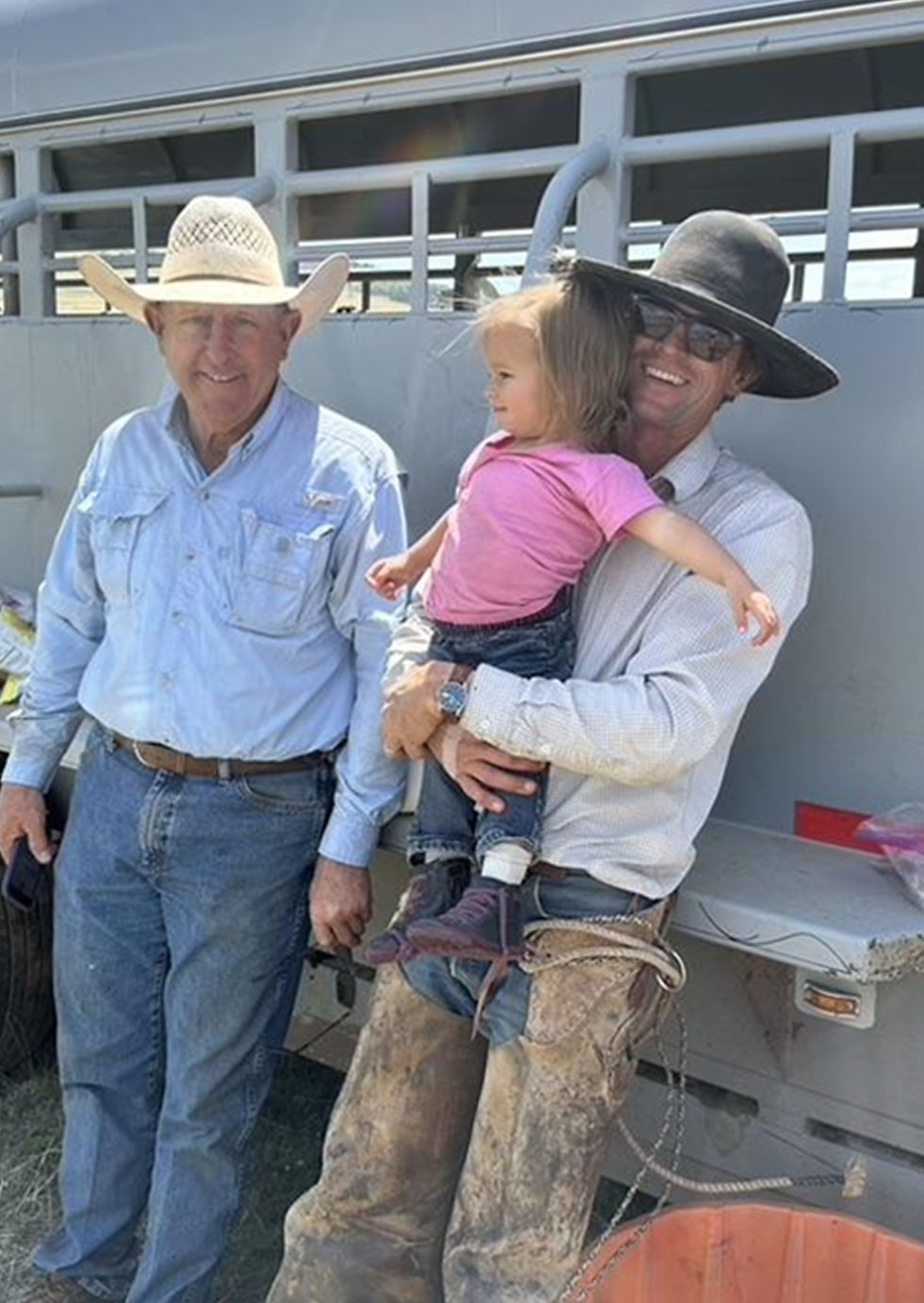
Partnerships are so important to make regenerative grazing work, particularly at this scale. One of the first things that Sam and I did when we moved in together into that wall tent on the yearling camp on the Mescalero Reservation was we formalized our partnership as a working LLC. I think we've all seen relationships really suffer by not having clear guidelines and accountability for how to work together. We had seen that happen, so it's one of the first things that we did before we started making our life together.
As Grass Nomads LLC, we worked for 4 summers together in Montana. We took care of around 3,500 head of cattle on a couple of ranches. It was a lot of work. They were yearlings, so it was fun and exciting with a lot of roping, a lot of riding, a lot of grizzly bears, and a lot of rivers. It was fun and beautiful, but the best part of it was the livestock company we worked with up there, Cayuse Livestock. We learned the value of such a convivial culture of working together. They're really serious about their management; they're serious about their stock handling, but not so serious that they can't have fun.
At the end of the day when we were shipping cattle, they’d say, “That went well” or “I liked how you did this” or “You handled that well.” They were encouraging, and I think we need to bring more of that into our work. Especially the work that's really hard.
Sam and I have regular check-ins about our marriage, and also just about how we work together. It's interesting how many of us work really hard maintaining our vehicles, tuning up horses, and starting our dogs. But when it comes to the most important relationships, we just kind of wing it sometimes.
We have a holistic context document. We are due to revisit it because it's a living document. People change and life happens so you should never be afraid to change.

I'm sure many of you have heard some version of this proverb from the Luo people in Africa. “A lone youth runs fast, with an elder slow, but together they go far.” Historically the Lou lived in centralized communities with decentralized governance structures. So, I imagine they had a lot of hard-won wisdom about how to work together, how to live together, because they had to; it was a matter of survival.
Those of us in production agriculture are less than 2% of the population in the U.S. And I think we are dwindling in our numbers. So, I’ve been thinking, what's the minimum we have to have in common to be willing to work together?

Sam and I are partnered with producers who a lot of people would look at across the room and assume are just conventional cattlemen. Then you get to know them, and you realize how creative they are, how much they are invested in their community. No matter what people look like, no matter where they came from, we need to look more deeply.
I think we live in a time right now where we are almost algorithmically influenced to look for all the reasons we shouldn't be involved with someone. As if relationships with people who think differently will contaminate us.
And I know it's easy for someone who looks like me to say, maybe we should just get along. And that's not what I'm saying. There are lots of important reasons to not associate with someone, to not go into business with them. But I don't think there's as many reasons as we tend to think. Or, as a lot of the powers that be would want us to think.
Just like grasslands need impact and rest and recovery in relationship with large herds of animals, we do too. We need change and healthy disruption in our relationships. If our hearts and minds change by virtue of working with people who are different from us, of finding ways to make opportunities together, then we can grow in ways we couldn’t have otherwise.
We've heard in Holistic Management circles, “manage for what you want instead of what you don't want.” We've heard in stockmanship circles, “make the right thing easy,” or “good movement draws good movement.” It reminds me of this quote from Goethe, “Correction does much, but encouragement does more.”
I think we should find ways to work together, like our lives depend on it, like the Luo people, because actually, in many ways, they do. How can we grow a culture of collaboration? How can we grow a culture of encouragement? And how can we remember that it is relationships, above and beyond pipeline diameter and pasture size, relationships that make stewardship possible at scale.


