
Loose Leaf Farm--Passionate Stewardship and Precious Food
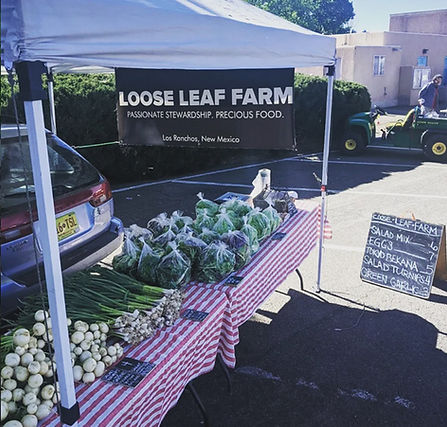
Sarah Robertson and her husband, Mark, are first generation farmers who have been farming in the Rio Grande Valley in Albuquerque since 2015. Prior to farming together Mark had a stint in the US Navy and then became a field engineer for Honeywell. Sarah got her bachelor’s degree from UNM in Communications and worked for a number of non-profits in the Albuquerque area. But as they experienced those careers they both quickly realized that their passions would be best served by farming for their community. With that new knowledge they started Loose Leaf Farm which has grown to the point that it supports Mark full-time and Sarah half-time. And, in 2024 they were named a “Local Hero” by edible magazine because of their quality produce and soil health practices.
Growing the Business

When asked what the motivation was for turning down secure, well-paying jobs to focus on starting a farm, Sarah commented: “Nutrition is really important and access to healthy food. I am a cancer survivor, so I put a priority on physical health and well-being and not sitting at a desk all day. For Mark , his job took him away from home a lot and one of our values in our holistic goal is being near family and friends. The job also came with a lot of stress which was not good for him. I guess the love of the land was ingrained in us both since we were children.
“There are other values we have in our holistic goal which has influenced how we have grown the business. We want to stay small so we aren’t being run by the business and we want to be part of our community who understands what we are doing and why we are doing it.

“We started the farm with both of us still working so it’s evolved as we’ve been able to earn more money so one of us could work part-time on the farm. We would take turns switching who got to work on the farm more depending on other jobs. In 2015 we only had a lease on ¼ of an acre but were able to produce a lot.
“As the farm got bigger, we were able to grow more food and make more money. In 2018 we picked up a lease for an entire acre, but the water situation as well as a co-farming arrangement and the sheer size of the place for type of equipment we had was too much. So, we cut the property in half and focused on that area since the whole place was full of bindweed. In 2021 we moved onto the property we are farming now. We still also farm the ¼ acre and use that for cut flowers and herbs to keep the land owner happy. We are now at a full acre of production on the new place which is just right for the 1.5 person hours we have available from the two of us.
“Our markets have grown over the years. We used to just do the Los Ranchos market and now we are one of the biggest and busiest booths there. We also serve Tiny Grocer and Bomvida Farms to You as grocery stores and serve restaurants like Los Poblanos and Farm to Table. Our CSA has grown to 35 families and we regularly have to turn down requests from other people who want to get on our waiting list. We really don’t have any problem moving our produce because we are known for our quality.” They also have an annual plant sale as an additional source of income.
Focusing on Soil Health

Sarah and Mark have been investing in soil health practices since they started their farm in 2015. “My grandmother’s yard in Taos was all food so I guess I was influenced by Grandma Lola from an early age,” says Sarah. “She had a front fence where she would grow peas and people could pick them as they passed. I also took some courses in sustainability when I was at UNM and we are both always reading about different soil health practices.
“We first learned about Holistic Management and the Holistic Cropping Planning when we went to the various training opportunities in the state whether it was at the NM Organic Conference, the Grow the Growers Program, or a Holistic Financial Planning course sponsored by NM Farmer’s Market Association.
“Holistic Management has had a huge influence on our farm, including helping us plan to make the farm a viable business. It has impacted our decision-making and our confidence in planning each step of the farm. We know we are not going to go belly up. We can trust the numbers and know that we weren’t crazy for doing this. All the case studies and the overall community helped us believe that we could farm this way, the way we wanted and make it. It was important to have that support when everywhere else we were being told that we were going to need more land and chemicals to succeed.”
Now Sarah and Mark steward an orchard with apples and peaches. The 4-acre farm includes one acre of intensive vegetable production and the rest of the farm is in cover crops which is grazed by the goats, chickens, ducks, geese and pigs. They have flood irrigation from the acequia for the orchard and a pond where they can catch water to use in the greenhouse and for pasture irrigation, but the vegetable crop is watered on drip irrigation from a well.

Their key challenge besides the heavy clay soil is the sporadic rainfall which averages around 8 inches and the heat of Albuquerque in the summer as well as the winds in the spring. Capturing every drop of rain is critical in this climate and that takes covered soil which is why cover crops are so important here as well as intensive planting and reducing soil impact and disturbance.
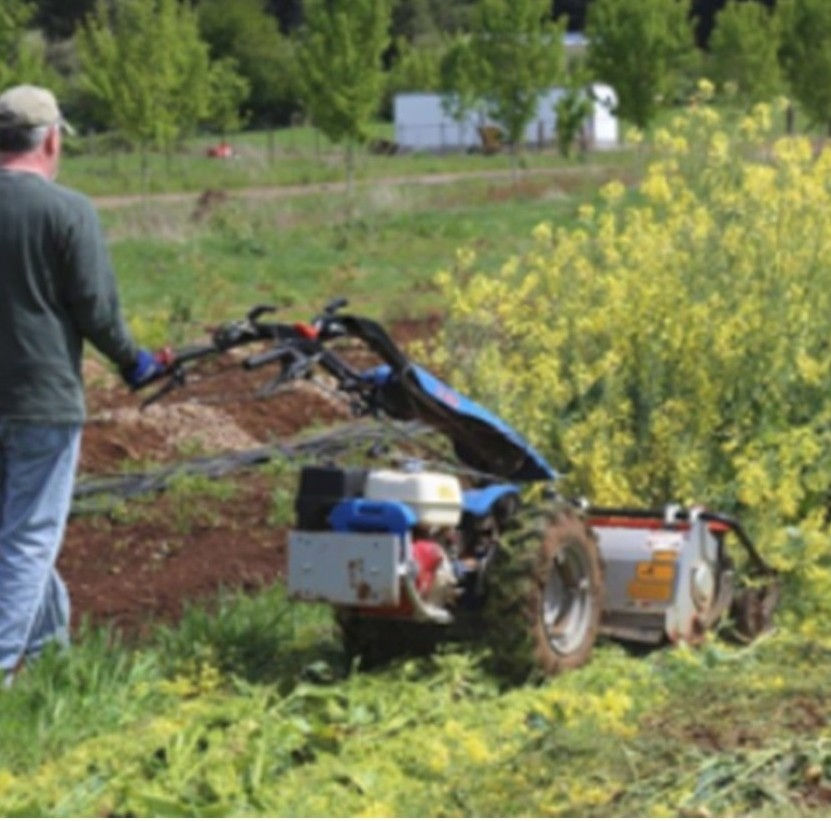
Their primary tools of choice to reduce impact and disturbance is a soil broadfork which they use to a depth of 14 inches. They then follow with a 30-inch power harrow on a BCS 749 to create a good seed bed that stirs the top but doesn’t disturb soil below. They also use the broadfork to harvest garlic, potatoes, and carrots. They like the light weight of the power harrow so there isn’t soil compaction. They also like the Earthway seeder and the Jang seeder as they must make the most of the limited labor force they have. They now have a paper pot transplanter that allows them to plant 264 transplants in one minute without bending over. They also use the seeders to get bone meal, bloodmeal, and langbeinite mix into the soil.
An unfair advantage that Sarah and Mark have on this leased property is a 100-feet by 30-feet greenhouse that is dug 5 feet down. They use this greenhouse to start their starts and that is where they use animal byproducts and langbeinite to amend the soil. They use a lot of compost on the vegetable field. While they do make some compost on-farm they also have to purchase it as well because of the amount they use. Sarah recommends testing compost you get as suppliers don’t always disclose their sources and Sarah purchased some that had horse manure and the horse had been grazing in a pasture that had repeated applications of herbicide. Consequently, she couldn’t grow anything but a monocot for 500 days after applying the compost. She almost gave up farming, but learned her lesson about compost.

Covered soil is critical for soil health anywhere, but particularly in the harsh, hot Southwest. Most of Loose Leaf Farm and walkways are covered in wood chips to reduce weeds and keep soil moisture. They also use cover crops extensively, often terminated by using the flail mower on the BCS to chop up the crop as mulch. They have even experimented with direct seeding into an area that they have just mowed down with the flail mower. They have also experimented with cover crops like an oat and pea mix and then moved the chickens onto the cover to add to their diet.
The Robertsons have also experimented with interplanting such as integrating a row with mustard on the outside edge of the row and frisee in the middle. This interplanting worked well because the frisee was a “one and done” type crop with one cutting, while the mustard had more of a continuous harvest throughout the season. They also use interplanting of tomatoes and carrots a lot as well as lettuces with peas and beans, because the lettuce will come out before the beans come up. Another combination they like is okra and baby bok choy.
For pest control they use a lot of marigolds and alyssum, on the edges of beds as an integrative pest management approach. They also use garlic planted for green garlic. The garlic is planted around collard greens and kale because the harlequin beetles don't like the garlic.
They have struggled with some plant diseases like powdery mildew because of the big temperature swings that come from being in the high desert. Crop rotation can help mitigate this kind of disease pressure along with other challenges like aphids, flea beetles, squash vine borer, allium white rot, and fusarium wilt. It can also help with improving soil structure, water retention, nutrient cycling, and increase the biodiversity that feeds soil life.
Integrating Livestock

Because Sarah and Mark live onsite, they have been able to integrate livestock which also is great for soil health. Goats provide manure, but they also help with weed management around the property. They can put the goats in a section of a field and then block it off for later use once there has been enough time from the “application” of manure. The goats are also great for education as their CSA has a lot of young children who love the goats. Mark and Sarah also get milk and meat from them.
The geese and ducks also provide the Robertsons with meat, pest control, and protection for the chickens. The chickens are great for cleaning up fields, establishing new fields, cleaning up the orchard, pest control, and for eggs and meat.
The Robertsons have pigs that are a Kune-Kune mix. With those genetics, the pigs don't root as much as other pig breeds. They are more typically a grazing animal so the Robertsons move them through the orchard with just electric tape to graze and pick up downfall. The pigs manure helps with the orchard’s soil health and, of course, they provide meat for barter and for the Robertson’s family. They also close the loop in the food waste chain as well, as they'll eat whatever the goats and the chickens won't.
Making a Living

Growing quality food is challenging enough, particularly in this high desert climate. But, making a living from it is even more difficult. It requires a clear focus on priorities, good soil health practices to lower input costs and increase production without sacrificing quality, strong relationships with a variety of customers from direct market to wholesale, labor efficient practices, and financial planning that focuses on profitability over production and includes investment in soil health to improve land resiliency.
Over the almost 11 years that Mark and Sarah have grown the farm, they had to fit the farming around a variety of off-farm jobs. But with a steady focus on the end game of reducing the need for off-farm income and investing in the soil and their ability to manage farm finances, as well as soil health and farm productivity, they are now making a living wage at approximately $23.50/hour. In addition, they have access to all the nutrient-dense food they want and a beautiful lifestyle on 4 acres of prime farmland in the Los Ranchos community.

In the last year they were able to gross a little over $55,000 from the combined markets of on-farm sales, farmer’s markets, CSA and wholesale restaurant and grocer sales. They are mostly working a 9-month year (March – November) during which they average about 60 hours a week between the two of them. Sarah’s part-time off-farm job brings in further income to help them pay down debt and increase their savings for other investments.
Sarah says the key principles and practices that have supported their success are:
● Planning for Profitability
● Diversity in crops
● Diversity in markets
● Diversity in soil health practices
● Diversity in species
● Diversity in monitoring
● Diversity in mindset
● Remain adaptable
● Never stop learning
When asked what her vision is for Loose Leaf Farm in the next couple of years Sarah says they’d like to own their own property so they can add more animals, invest in planting more perennials, and create a farm hub for meat and milk and develop a little grocery shop. They have some savings and another house they could sell for a down payment. With their farm income they could meet land payments and will be approaching Farm Service Agency and Veteran Affairs for loan options. They are shopping around for the right place that has good water and 2-3 acres so they can graze small stock and have fruit trees somewhere in the Albuquerque area where they can continue to serve the families they are feeding now.


