
Texas Regenerative Grazing Workshop Provides Key Information for Texas Graziers
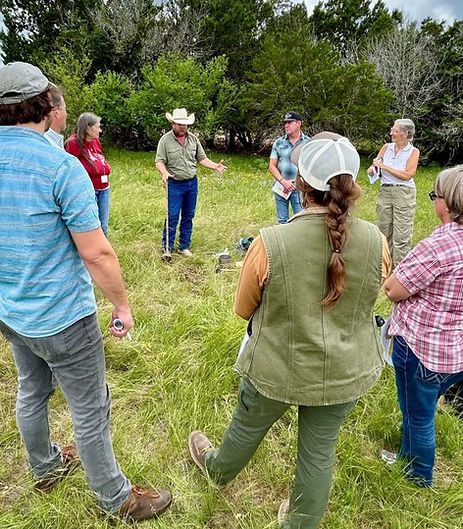
Over two days in Canyon Lake, Texas, 15 land stewards gathered at Pure Pastures for Fundamentals of Regenerative Grazing, organized through the partnership between Holistic Management International and the Small Producers Initiative.
The participants represented a familiar story in regenerative agriculture, some stepping into management of family land, others having recently acquired acreage and eager to steward it differently than what they had previously seen modeled.
What united the group was not years of experience, but curiosity. Many arrived looking for answers to the question, “What should I do?” By the end of the workshop, there had been a subtle but important shift toward asking, “Why should I do it?”
Participants began to understand that regenerative grazing is not about applying a prescribed practice or copying someone else’s system. It is about learning to interpret what their land, resources, goals, and conditions are asking of them.
Throughout the workshop, we explored the foundational principles of regenerative grazing and challenged the idea that grazing is simply moving livestock from one pasture to another. Regenerative grazing requires observation, adaptation, and understanding that land is a living system.
Participants learned that successful grazing management begins with reading the land itself, looking at ecosystem function, plant recovery, ground cover, litter, biodiversity, animal impact, and how water moves across the landscape. Together we explored the role of context: understanding the humans involved, the finances, and the ecological realities of the land, before deciding what management tools to use.
A major highlight of the workshop was hearing from Aaron Reynolds with NRCS, who did an outstanding job walking participants through the support available to producers. Many landowners do not realize there are conservation programs designed specifically to help implement practices that improve ecological function while supporting operational goals.
Aaron shared how programs such as CSP, EQIP, and the newer Regenerative Pilot Program can assist producers in establishing infrastructure and conservation practices that make regenerative grazing more feasible. Water systems, fencing, prescribed grazing support, and other improvements can reduce barriers that often keep producers from implementing what they know needs to happen on the land.
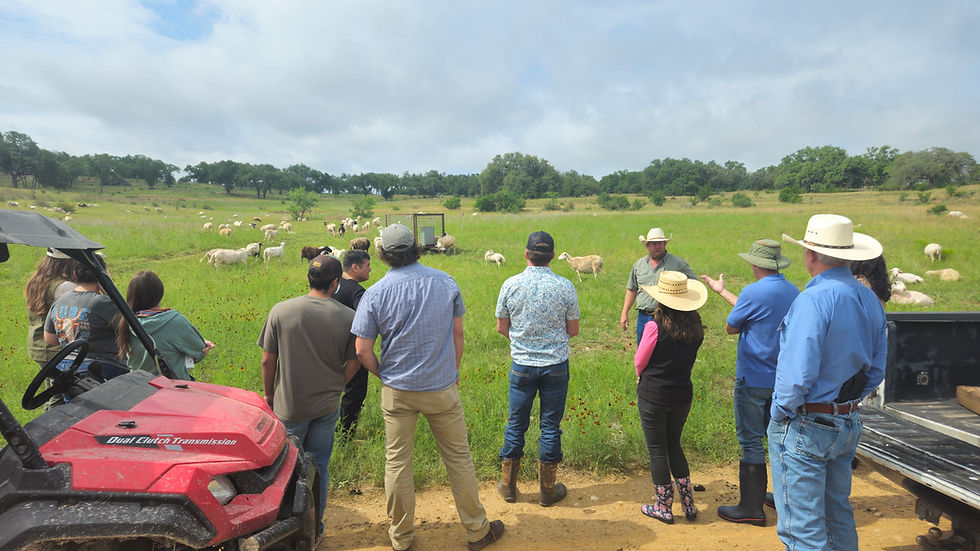
One of the most memorable demonstrations of the workshop came through rainfall simulation.
Although the Small Producers Initiative was unable to bring the full rainfall simulator, the tabletop rainfall simulator still proved to be incredibly effective at making the lesson visible.
Using soil collected directly from Pure Pastures alongside soil from a newly acquired property that had experienced long-term set stocking, overgrazing, and minimal litter cover, participants watched two very different outcomes unfold. The regeneratively managed Pure Pastures soil, after approximately six years of intentional grazing management, absorbed water rapidly with significantly lower runoff. In contrast, the comparison soil accumulated water much more quickly at the surface, runoff occurred earlier, and infiltration was noticeably reduced.
What participants could see in real time was something often discussed conceptually but harder to appreciate until witnessed firsthand: management leaves fingerprints on the land. The demonstration reinforced an important principle of regenerative grazing, that regenerative grazing is not simply about livestock movement. It is about creating conditions that improve the water cycle, support biological activity, protect soil surfaces, and increase resilience over time.
Drought management was addressed during the workshop’s drought management session, which felt particularly timely given current conditions in Central Texas.
Participants learned that drought management is not something that begins when rainfall stops. It begins much earlier through grazing planning, maintaining adequate recovery periods, protecting litter cover, monitoring forage availability, and making proactive decisions before conditions become critical.
To apply these concepts, participants worked through a drought management case study designed to help them understand both how to monitor for drought conditions and what decisions become available once the determination is made that drought is occurring. Rather than focusing only on rainfall totals, the discussion centered around interpreting signals from the land and understanding the tradeoffs associated with different management responses.
The case study guided participants through questions such as whether forage growth was slowing, how much forage was actually available, how many animal days remained, whether purchasing feed could be financially justified, and whether reducing livestock numbers would ultimately create a stronger long-term outcome. Through the discussion, participants explored drought management principles including combining herds to improve efficiency, strategically using supplemental feed, and reducing animal numbers when necessary.
Given the complexity of managing livestock according to what the land is communicating to the producer, while also managing finances and maintaining quality of life, we concluded the workshop by introducing Holistic Management®’s Decision Testing Questions.
Using a real decision that Pure Pastures is currently contemplating, participants worked systematically through the seven testing questions to evaluate whether the proposed action moved them toward or away from their desired outcomes.
Participants saw the value of having a structured and systematic way to evaluate complexity. Rather than reacting to a single problem or optimizing for one outcome, the seven questions encouraged participants to consider the ecological, financial, and quality of life implications of their decision together. It demonstrated that stewardship decisions rarely exist in isolation and that a systematic process can help producers navigate complexity with greater confidence.
For many, this brought the workshop full circle.
The biggest takeaway became clear:
There Is No Recipe
Participants quickly realized there is no perfect stocking density, recovery period, grazing chart, infrastructure design, or drought strategy that works everywhere.
Management begins with context.
The role of the steward is not to find the right answer, but to ask better questions, observe outcomes, and adapt management accordingly.
The workshop reinforced that regenerative grazing is not about following a recipe. It is about learning to observe, interpret what the land is communicating, and make decisions that consider ecology, finances, and quality of life together.
100% of those participants completing surveys noted that the workshop was excellent and that they would recommend it to others. They also noted that their knowledge about regenerative grazing had increased. Overall they managed over 8,000 acres. They noted how inspiring the course was and really appreciated the enthusiasm and synergy of presenters and participants. They also noted that they enjoyed learning the grazing principles and practices as well as what good grazing forage looks like.
Thank you to Pure Pastures for hosting, to Aaron Reynolds for sharing valuable resources, and to the Small Producers Initiative willingness to collaborate with HMI and creating opportunities for producers to learn, connect, and steward land more regeneratively.


