
Tribal Workshops Focus on Ranching with Nature
Guest blog by Dana Bonham

There are numerous aspects to ranching in partnership with the natural world. Native American ranchers, agricultural agency members, and conservation educators joined in a useful training in one component of Ranching with Nature in late March in Farmington, New Mexico.
37 attendees the first day, and 39 the second day, drove in from counties throughout New Mexico and Arizona to learn more about opportunities for ranching led by Delane Atcitty of Arrowhead Resource Management. Atcitty is also First Vice President of the Society for Range Management and is the Executive Director of Indian Nations Conservation Alliance. (INCA). INCA and Holistic Management International partnered on the training.
61% of attendees identified themselves as Ranchers, 39% identified as Ranchers/Ranch Employees, and 16% identified as agriculture professionals.

100% of attendees were American Indian/Alaska Native, with the majority being from the Navajo Nation (Diné), Pueblo of Jemez, or Taos Pueblo.
“There was a strong representation of Native producers at the workshop,” stated Atcitty. “I’m looking forward to hosting more events like this in the future,” he added.
52% of the Native producers who attended were under the age of 55 years. “That is important,” Atcitty added, “We need to focus more on engaging with younger people who want to be in ranching, especially in indigenous communities.”
With 30+ years’ experience in agriculture, farming, and conservation management as well as a Bachelor of Science degree in Agri-Business and a Master of Science Degree in Ranch Management/Agri-Business, Atcitty has worked in all segments of the cattle industry from cow-calf, stocker, and finishing cattle at the feedlots.
At the Indian Nations Conservation Alliance, his major projects include tribal conservation youth corps projects, a large-scale virtual fencing project, creating an INCA Trading App to reestablish ancient tribal trading of natural resources, Climate Smart grant projects utilizing tribal resources to add value to the normally commodity sold livestock, and starting the Indigenous Grazing Lands Coalition as a hub for the 55 million acres of tribal rangeland.
Hosted with support from the Thornburg Foundation and the USDA Natural Resources Conservation Service, Holistic Management International and INCA brought in another key partner – Dawn Hnatow.

Hnatow, owner and founder of Cattle Up Stockmanship, was born into a ranching family in Canada. She has worked with livestock her entire life and spent numerous years under the direct mentorship of Bud Williams. Their many years together forever changed the trajectory of her life and she now spends her time passing on the wealth of knowledge she gained during those countless experiences.
Hnatow led training in principles and practices in working calmly with cattle, teaching proper handling skills to help stock more effectively drive, move, sort, and pen.
“It always gets interesting when folks get in the pens with the cattle. I was happy to see how quickly the group took to the stockmanship lessons,” stated Hnatow.
Participants did enjoy the hands-on learning with the cattle as reflected in the positive evaluations:
“I found the entire training useful. I liked how the stockmanship helped with the attitude with the cows. I liked learning how I need a lot of patience with both myself and the animals.”
“We sometimes have a challenge working cattle and getting them to load, with this stockmanship training it will be a lot easier for me and our crew. Good hands-on training!”

90% of participants noted a knowledge gain in effective stockmanship and handling skills.
Furthermore, 100% of participants indicated they intended to implement what they learned at the event and 100% would recommend the training to others.
Many, in fact, made direct requests for similar events.
“This was great, but we need more training like it throughout the Reservation. It was a great experience!
“Please bring workshops like this to more indigenous communities so our people can learn and understand.”
“We need a lot of outreach like this for Native stockowners through the Navajo Nation.”
“I would focus the training toward the younger adult like me because it would help the Tribe, as well as our economic state.”
That statement certainly rings true, as part of the training provided strong numbers demonstrating how calmer animals result in greater profit/gains for the producer.
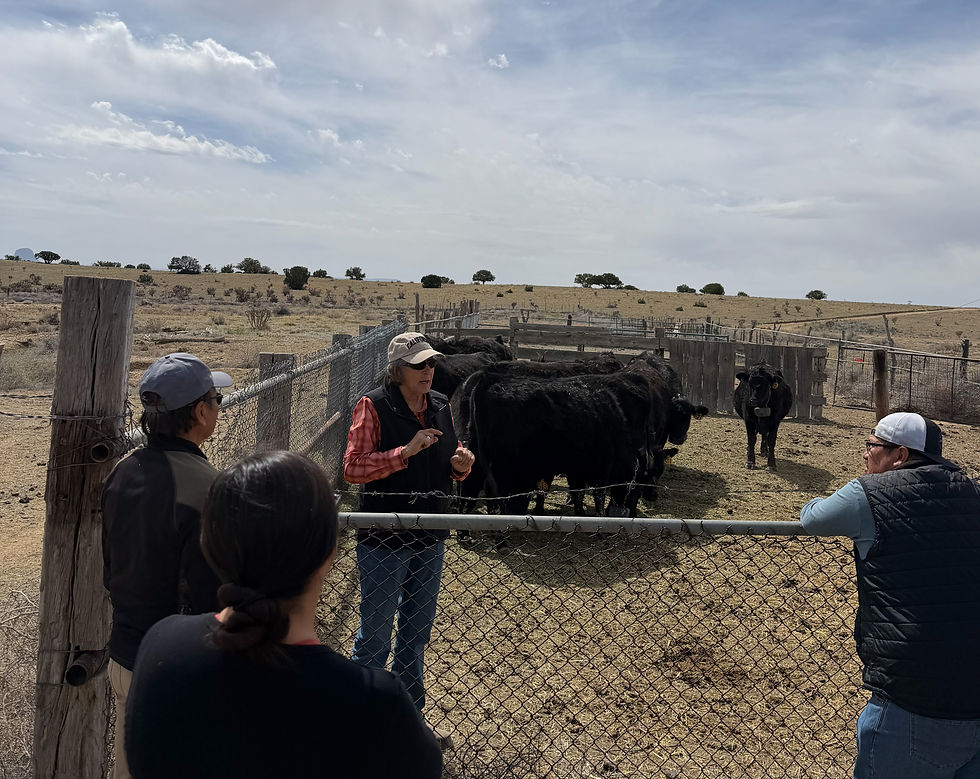
A third day of training was held for Native ranchers at the Pueblo of Jemez, with time on the land with cattle in the afternoon.
Attendees echoed thoughts about the training.
“I really liked the techniques that were taught and how effective they proved to be in the working pen.”
“Learning about stockmanship was very helpful in thinking about issues we’ve faced working cattle in the past.”
“I learned more about what we can do as a Tribe to improve our rangelands through regenerative agriculture.”
These participants manage almost 3 million acres and influence a little over 21 million acres. We are grateful for their stewardship of the land and their desire to improve their management of the land and their animals.
Thank you to the Thornburg Foundation and the United States Natural Resources Conservation Service for supporting the workshop. Our sincere gratitude to Duane Aspaas of Aspaas Ranch and Jonathan Romero at Pueblo of Jemez for providing access to their cattle. And big thanks to Daryl Lucero of Pueblo of Jemez for helping organize the training.
For more information about this kind of programming, please visit


